
Aging in Place. But Which Place?
The Twin Cities metro market for senior housing is active. But that doesn’t mean your older neighbors have any plans to move.
By Jon Commers | May 1, 2025

Hennepin County—Senior Housing Facilities and Amenity Access: The location of senior housing facilities in Hennepin County generally reflects broader residential patterns among the county’s urban, suburban, and rural areas. Data sources: MnGeo, OpenStreetMap, Metro Parks Collaborative, Costar, Overture Maps Foundation.
2025 PRINT ANNUAL
This interview appeared in the 2025 ENTER print annual, available for purchase here.
The size and influence of the Baby Boomer generation has dominated news cycles and public dialogue for decades. Its impact is especially clear in the housing realm. According to Freddie Mac, Baby Boomer households, which comprise 21 percent of the population, own 38 percent of U.S. homes. Empty-nest Baby Boomers own 28 percent of three-plus bedroom homes, twice as many as Millennials with children. Favorable economic conditions including wage growth, and real housing costs that today appear modest, have over time supported the Baby Boom generation’s dominance of U.S. housing supply.
Baby Boomers have had an equally well documented influence on senior housing, but the reach of this marketplace extends even more broadly. In addition to the “silver tsunami” associated with the Baby Boomers, the approaching needs of Generation X are projected to comprise a supply gap of $800 billion worth of senior housing products nationally, according to MarketWatch. Housing choices that Baby Boomers and Gen X households make in the coming years will dictate the senior housing landscape while also shaping the amount and types of housing available for younger demographic groups.
What About Location?
Location plays a leading role in where older generations choose to live. A housing industry survey collected last year by Clever Real Estate indicated that 54 percent of Baby Boomer homeowners who responded expressed plans never to sell the home, and to occupy it for the remainder of their lives. Among the key factors: The home suits their lifestyle needs; they prefer aging in place; and their mortgage is paid off, or what debt remains is borrowed at rates lower than what the current market offers. Notably, only 19 percent of these respondents indicated that their reluctance to move is about community ties and friendship in their existing neighborhood.
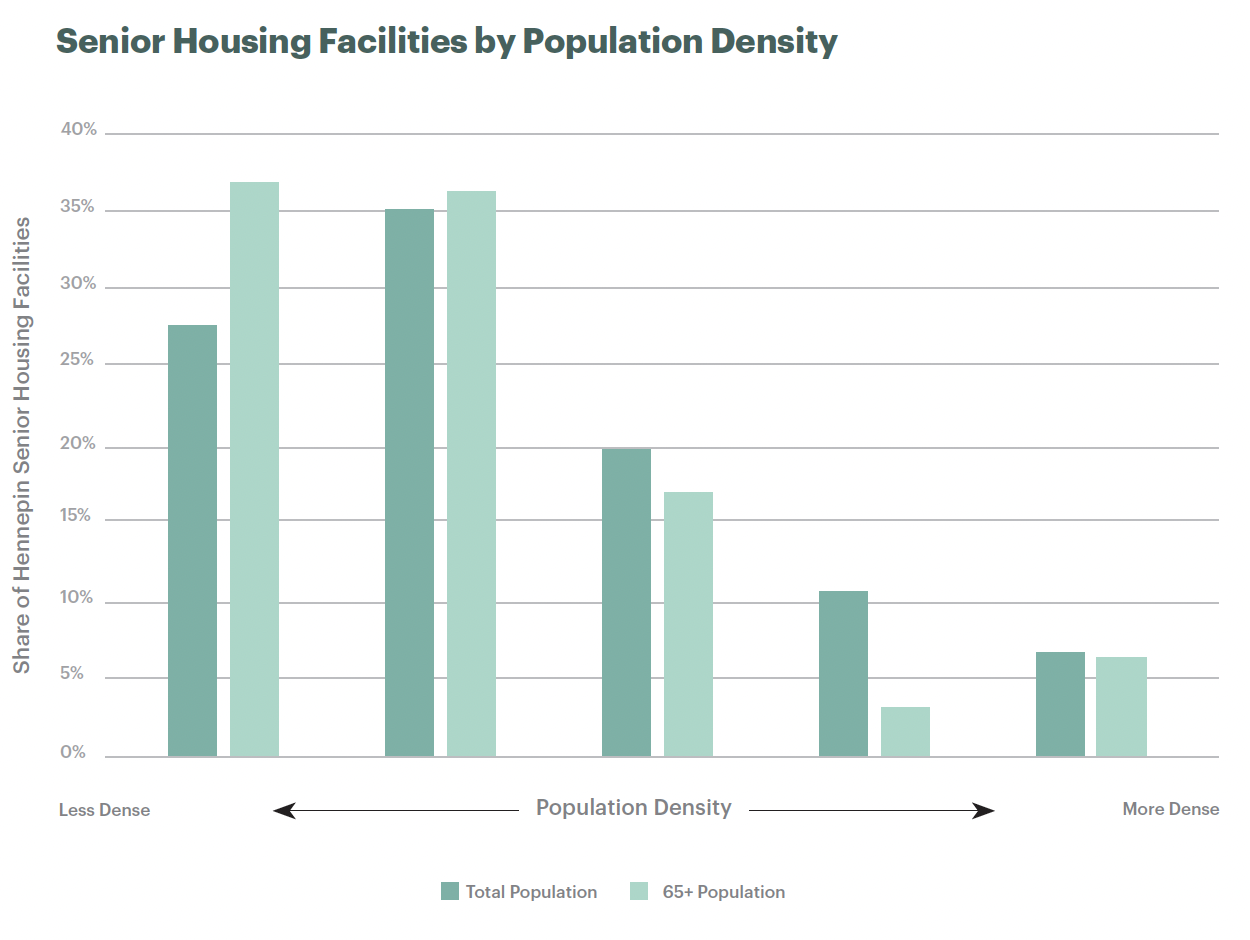
Graph: The proportion of senior housing facilities in less and more dense areas of the region approximates where in those areas the population as a whole lives.
In the Minneapolis–St. Paul metro market, all kinds of senior housing are available, with more under construction. Active senior housing, assisted living, and continuum of care extending to memory care are distributed geographically, as the map of Hennepin County helps illustrate. The map’s dots note senior housing facilities, and the layered pink coloration represents density of nearby businesses, services, and amenities. Senior housing is sited across the populated areas of Hennepin County, in a pattern generally consistent with where county residents as a whole, and those over 65 years of age, currently live.
The adjacent bar graph portrays this dynamic as well: Across five groupings of the least to most densely populated areas of the county, the location of senior housing generally aligns with the home location of residents as a whole and those over 65 in particular.
Senior housing is not the only housing for seniors, of course. In addition to the large group of older homeowners who intend to age in place, others are opting for choices such as accessory dwelling units or congregate housing serving all ages. Maintaining a healthy marketplace for each age group, as residents progress through phases of life with changing demands, will require production of housing to meet a range of lifestyle needs and affordability. Guiding construction of housing for seniors across areas with a range of development density will be important in timing the next iteration of production, reuse, and community building.
Carly Hanson provided the analysis and cartography for this article.
Related Articles

