
Creating Community: A Conversation with Jamie Verbrugge
The president and CEO of Catholic Charities Twin Cities on shaping services, spaces, and systems to help people move from crisis to stability
Interview by Mary-Margaret Zindren, Hon. AIAMN, CAE | October 15, 2026
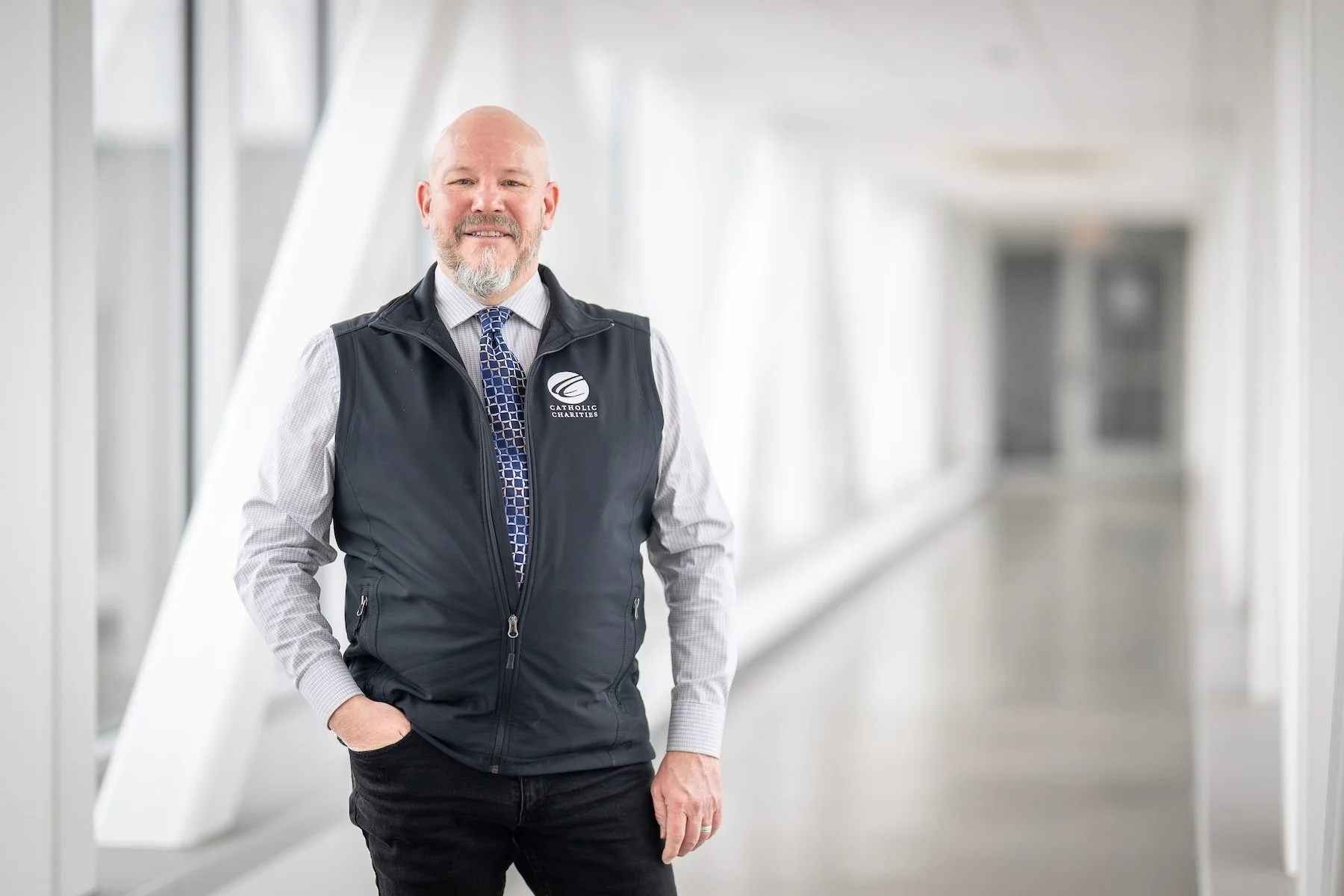
Jamie Verbrugge in the skyway linking the Higher Ground St. Paul shelter with the St. Paul Opportunity Center and Dorothy Day Residence. Photo by Chad Holder.
2026 PRINT ANNUAL
This interview appeared in the 2026 ENTER print annual, available for purchase here.
For more than 150 years, Catholic Charities Twin Cities has been a cornerstone of the community. The organization operates 24 programs across the metro area, serving some of the most vulnerable populations—people experiencing homelessness, hunger, and employment challenges; children in need of care and educational opportunities; and older adults who are isolated and need support as they age.
Since January 2025, the organization has been led by President and CEO Jamie Verbrugge. Before stepping into this role, he served as city manager for the City of Bloomington. In that position, he worked with ENTER publisher Mary-Margaret Zindren about 15 years ago, when she was with the League of Minnesota Cities.
We’re talking at Catholic Charities’ Dorothy Day Place campus here in St. Paul, designed by Cermak Rhoades Architects—now LHB. It almost feels like a city within a city.
I think that’s fair. It starts with the principle that every human being has intrinsic dignity. From there, we create communities where people feel belonging, inclusion, and value.
Many of the people we serve feel invisible or isolated—or outright shunned. Our goal is to create communities where every person who walks through the door is treated with dignity, compassion, and respect.
People who are out on the street may be isolated, but they do have connection, and it’s often with others who are also experiencing homelessness. Providing a place where they can have community is important.
Some people might think of a “city within a city” as a kit of parts—a daycare here, a clinic there, residences over there. But you describe it more as a living community.
Yes. To me, a city isn’t just a geographic boundary. When I was a city manager, my purpose was helping create places that improved quality of life. But that work often happens at a 30,000-foot level.
What drew me to Catholic Charities is that we make a difference every day at a personal level—sometimes in lifesaving ways. And it’s not just for the people we serve; it strengthens the entire region. The role we play is essential to creating a thriving Twin Cities.
A thriving Twin Cities includes thriving downtowns. Catholic Charities plays an important role in the future of downtown St. Paul.
I give a lot of credit to the people who developed this project. It’s an award-winning model because it consolidates services in one place and does so in a way that reinforces dignity. And it sits right at the front door of downtown St. Paul, which sends a powerful message about the city’s values.
But the last decade has been challenging with COVID, the opioid epidemic, remote work’s impact on downtown economies, and disinvestment in commercial districts. Because of these challenges, we are seeing more neighbors turn to us for help, and many of them are facing more complex, urgent needs.
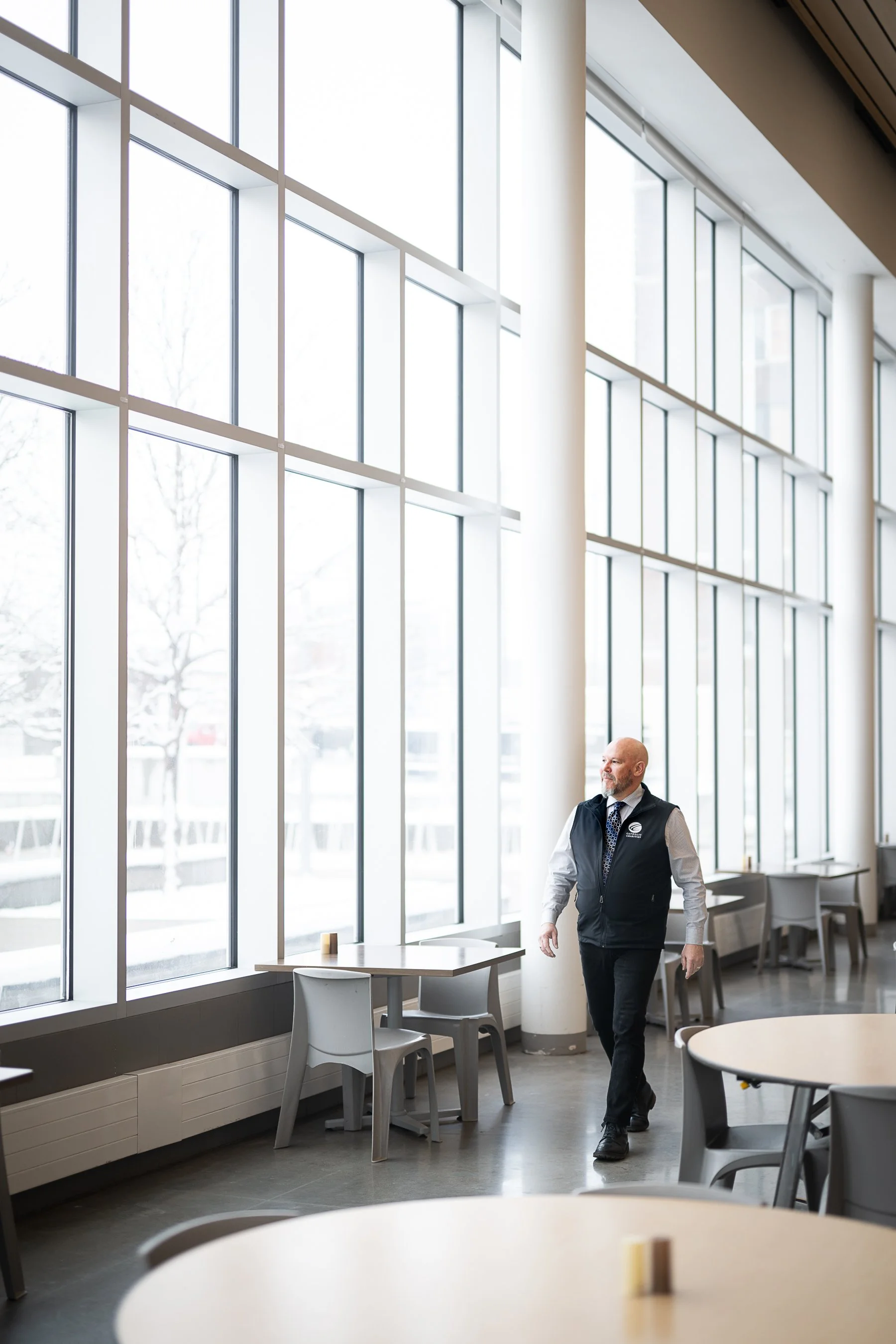
Verbrugge in the dining hall, where free meals are served. Photo by Chad Holder.
The city is working hard to rebuild a vibrant downtown, and we’re part of that conversation. What we do helps provide opportunities and support for people who live on the margins of our community.
We also partner closely with the business community. The CEO of Ecolab convenes a homelessness roundtable that brings together providers, corporations, foundations, and government. That coordination is critical—not just for delivering services but for aligning resources. And what’s good for downtown is good for Catholic Charities. A thriving local economy creates opportunities for the people we serve.
One of the things I love about AIA Minnesota architects and designers—and about city managers—is that you’re all systems thinkers. How does systems thinking inform your work at Catholic Charities Twin Cities?
We operate in a unique space because we are a full lifespan spectrum service. We’re best known for housing services and work with people experiencing homelessness, but we also provide aging and disability services. In fact, one of the fastest-growing populations experiencing homelessness is older people.
At the other end of the spectrum, we serve very young children. Our Northside Child Development Center supports about 120 kids, from six weeks to 12 years old, with early education and childcare. More than 90 percent of preschoolers met or exceeded standards for kindergarten readiness. The program also gives families on the economic margins access to very affordable childcare, so they don’t have to choose between working or staying home with their kids. It helps create economic opportunity and mobility.
As you look ahead and set Catholic Charities’ strategic direction, you’re doing so amid real financial challenge and changing priorities of governments and funding partners.
We have a couple major opportunities. One is correcting the mismatch between the revenues that support our work and the actual cost of providing services. Permanent supportive housing and emergency services are chronically underfunded. Government reimbursements and grants simply aren’t keeping pace with rising costs.
Part of our strategy is figuring out how to make the work financially sustainable, so we don’t jeopardize the mission. The other piece is determining where we can add the most value in improving people’s economic conditions—where we can exert leverage for greater impact.
For example, historically, there has been more support for childcare assistance. There is opportunity both to grow those services and to influence the system toward more sustainable funding.
“What drew me to Catholic Charities is that we make a difference every day—sometimes in lifesaving ways. And it’s not just for the people we serve; it strengthens the entire region.”
But that’s challenging when the state is facing a multi-billion-dollar deficit in the next biennium, and when federal policies are shifting—such as reductions in Medicaid or new approaches from HUD around the Housing First philosophy.
You’re dealing with competing theories of change about how to address homelessness.
Yes, and this is where systems thinking comes in, in a big way. For the last couple decades, the dominant approach has been Housing First: Get people stably housed, then provide wraparound services to address the issues that contributed to their homelessness. This approach works. Last year, more than 90 percent of the residents living in our housing programs maintained their housing or exited to a positive destination.
When many people arrive at our doors, they’re focused on survival. If you think about Maslow’s hierarchy of needs, they’re operating at the most basic level.
What seems to be emerging from the federal government is a stronger emphasis on personal accountability and demonstrating progress. Some of our supporters ask the same question: “Where does personal responsibility fit in?”
And what’s your answer?
At the point in time when we encounter people needing our services, they are often not in a place where they are able to make those commitments. We walk alongside people to try to get them to the point where they are ready to take those next steps. That is the essence of supportive housing, and the approach works.
The design of your buildings also seems to support people moving up Maslow’s hierarchy of needs.
Yes. The buildings are intentionally designed around that progression. Our Higher Ground Minneapolis building is a good example. The first level provides nightly shelter—meeting immediate needs. The next level is pay-for-stay, a longer-term shelter for people who want more stability and can pay a small nightly rate. Above that is permanent supportive housing.
From a systems perspective, that model works. What the federal administration often says is that homelessness is increasing, so the model must not work. But that mindset overlooks the broader forces that cause homelessness in the first place.
From a design perspective, what lessons have you learned that might help others creating or renovating facilities focused on homelessness?
One of the biggest lessons is that we don’t have the capacity or expertise to provide every service people need. Partnerships are essential.
You even have partners located in this building.
Exactly—and the building was designed for that. Ramsey County has case managers here. We host healthcare partners, including a foot clinic run with the St. Catherine University nursing program. For many of our residents, their feet are their primary mode of transportation, so foot care is essential. We also have mental health providers, chemical health resources, and space for veterans’ services.
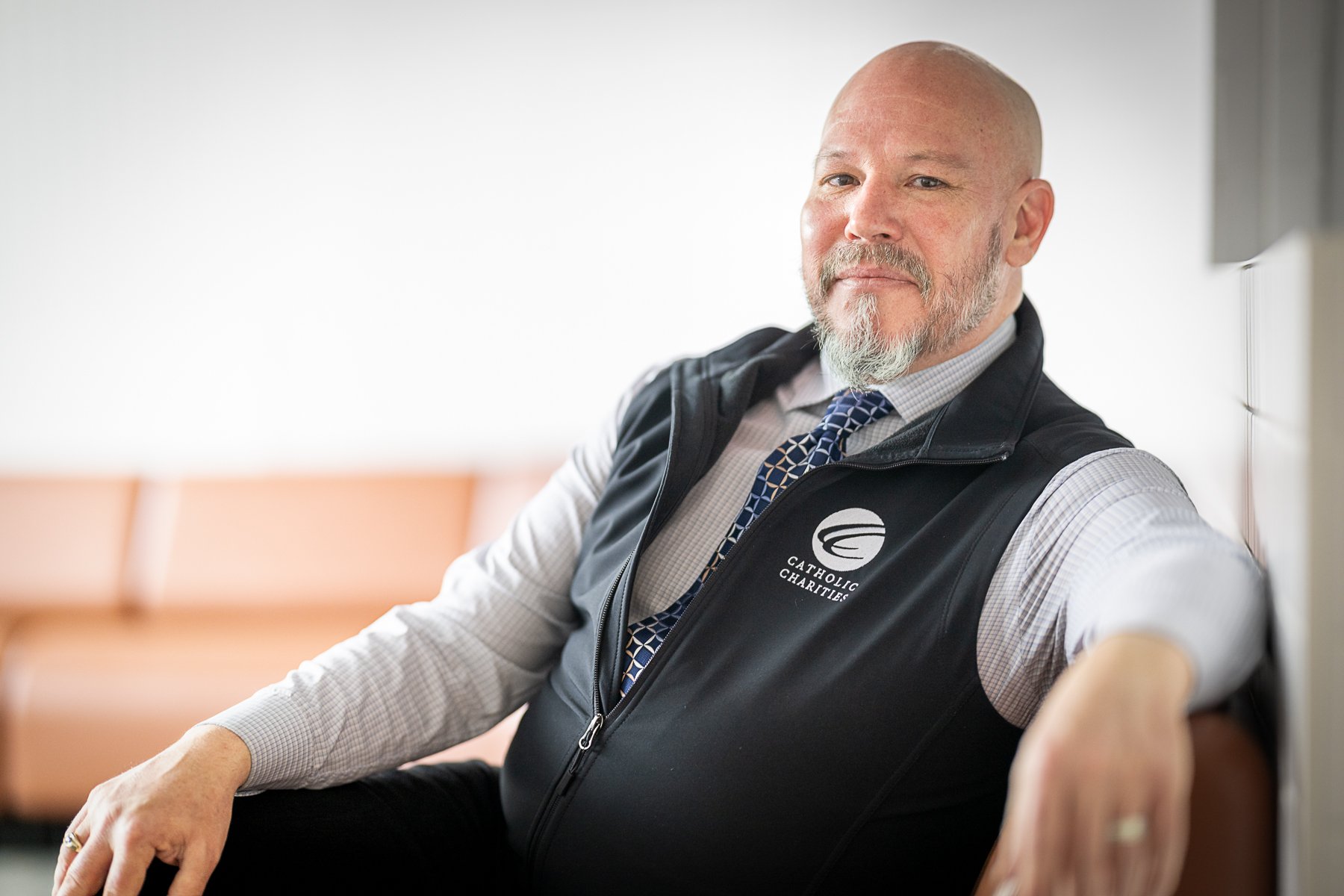
Verbrugge in a multipurpose meditation room, where trauma-informed design features include a softly curving wall. Photo by Chad Holder.
Many people experiencing homelessness have experienced trauma. Are there specific considerations that stand out to you in terms of trauma-informed design?
Trauma-informed approaches are central to our work and reflected in the design. Many of the people we serve have had interactions with the criminal justice system, so we don’t want our spaces to have an institutional feel. You’ll see a lot of natural light and fewer hard surfaces.
In the residential units, we try to create spaces that feel more home-like, even though the housing model is primarily single-room occupancy with shared facilities. The challenge is designing welcoming spaces that don’t reinforce trauma while staying within financial realities.
You mentioned veterans’ services. In recent years, there were big gains made in reducing the number of veterans experiencing homelessness. How might that success inform the future of your work?
That statewide effort to end veteran homelessness was largely successful. It worked because the system was intentionally redesigned—the structure, the funding, and the supports.
I believe we could apply that same systems thinking to ending homelessness more broadly. It would require resources and a fundamental rethinking of how services are structured, but we’ve already shown that it can work.
You and I are both policy nerds. You know that if no one “owns” a problem, it rarely gets the resources needed to solve it. In Minnesota, no statute clearly assigns responsibility for homelessness. The result is a fragmented system with diffuse accountability. Until the state takes ownership, it will be difficult to significantly improve the situation.
How can Minnesotans support the work of Catholic Charities Twin Cities?
Volunteering is a great way to understand the work and make an impact on your neighbors. We have more than 4,000 volunteers who help us—from serving meals in our kitchens to sorting supplies for clients to connecting with guests in our shelters.
We also rely on donors—more than 7,000 of them—giving anywhere from $10 to $1 million a year. In a challenging philanthropic environment, maintaining that support is critical.
And the third piece is advocacy. We work to influence systems change—advocating for justice, equity, and the resources needed to address homelessness. We participate in coalition building to try and influence public policy. There are opportunities to help design a system that will lead to better outcomes.
On a personal level, what inspires you and your team to keep doing this work?
I’ve always valued being part of mission-driven teams, both in my city career and here. What’s been encouraging is how deeply committed the staff at Catholic Charities are. They understand the assignment and feel it deeply.
The compassion and care they show for the community we serve is remarkable. There’s a real sense of solidarity here, and that’s what ultimately drives the work.
Related Articles